Logo Prospekto
Mar. 25, 2026
Structured Finance
6 min read

What a Production Cashflow Report Looks Like

The Report

We ran Mercedes-Benz Silver Arrow Compartment 20, a EUR 744 million German auto ABS deal, through a production cashflow engine. The full report is public.

The output is a self-contained HTML file. Sidebar navigation. SVG charts. Deal summary, capital structure analytics, bond cashflows, pool performance, swap settlements, waterfall trace, and a validation suite. One file you can open, review, and forward to a colleague. No logins. No external dependencies.

The Deal

Silver Arrow Compartment 20 is from Mercedes-Benz's long-running auto ABS program, issued October 2025. Two tranches, sequential pay, with a swap converting the pool's fixed-rate receipts into floating-rate payments for the senior notes.

Issuer
ValueSilver Arrow S.A., Compartment 20
Collateral
ValueGerman auto loans (Mercedes-Benz)
Original Pool Balance
ValueEUR 744,699,978
Cutoff Date
ValueAugust 31, 2025
Closing Date
ValueOctober 30, 2025
First Payment Date
ValueNovember 17, 2025
Stated Maturity
ValueJune 15, 2033

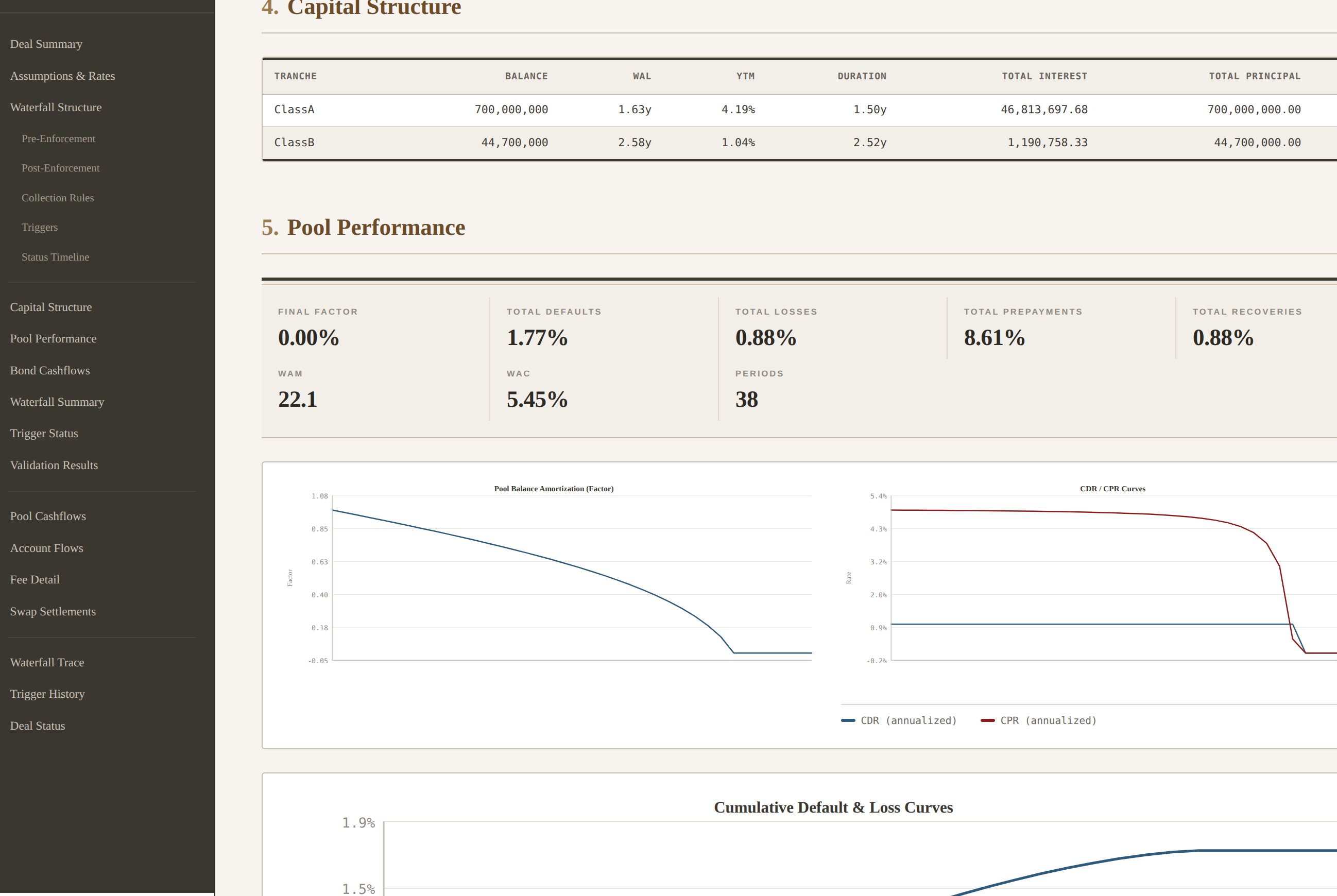
Capital structure, with analytics from the engine's base case:

Class A
BalanceEUR 700,000,000
RateEURIBOR + 43bps
WAL1.63 years
YTM4.19%
Duration1.50 years
Class B
BalanceEUR 44,700,000
Rate1.00% Fixed
WAL2.58 years
YTM1.04%
Duration2.52 years

Class B provides 6% credit enhancement through subordination. Swap fixed at 1.9519% against one-month EURIBOR.

Base case assumptions: 1% CDR, 5% CPR, 50% recovery rate, six-month recovery lag, EURIBOR flat at 3.50%.

Under these assumptions, Class A retires in period 32 (June 2028) with EUR 46.8 million in total interest paid. Class B clears one period later. Both tranches pay down well before the stated maturity in 2033.

What the Analysis Shows

Two things worth highlighting.

The engine is transparent about its boundaries. The offering circular defines the full priority of payments for this deal. The engine models the mechanics that drive cashflows: bond interest and principal in sequence, swap settlements, reserve management, fee payments, and the excess spread sweep that returns residual economics to the originator. Items it cannot model from the offering circular alone, such as tax obligations, subordinated loan payments, and indemnity claims, are explicitly marked in the report. Not silently skipped. Marked. In a production workflow, knowing what the model does not cover is as important as knowing what it does.

The swap tells a rate story. With EURIBOR at 3.50% and the fixed leg at 1.95%, the deal receives a net cash settlement every period. That settlement flows into the waterfall before bond interest payments. It is additional cash the structure can use. If EURIBOR drops below the fixed rate, the direction reverses: the deal pays out on the swap, reducing cash available for the waterfall. Where that inflection point sits, and how it affects tranche paydown timing, is exactly the kind of sensitivity a portfolio manager would want to stress test.

How the Pipeline Works

The report above is not a one-off. The pipeline that produced it has three stages.

First, an AI agent reads the offering circular and constructs a structured deal description. Every parameter identified, cross-referenced against the document, and organized into a canonical format the engine can consume. That is where the AI's work ends.

Second, a deterministic cashflow engine runs the scenario. Period-by-period waterfall execution, swap settlements, fee calculations, balance tracking across 38 periods. No AI in the loop. No language model doing arithmetic.

Third, a standardized report template renders the results. Same sections. Same charts. Same validation checks. Every deal. Every time.

That separation is what makes the output reproducible. Run the same deal with the same assumptions tomorrow and you get the identical report. Run a different deal and you get the same format, the same validation framework, the same visual quality.

The reports can also be exported to PDF for committee presentations or LP reporting.

Every Number Verified

Eight automated validation checks run after every scenario. In this report, all passed.

Non-negative balances
ResultPASS
Bond balance monotonicity
ResultPASS
Bond principal within pool bounds
ResultPASS
Account balances non-negative
ResultPASS
Pool fully amortized (final factor 0.00%)
ResultPASS
Cash conservation (lifetime imbalance: EUR 0.00)
ResultPASS
Result completeness
ResultPASS
No cliff risk detected
ResultPASS

Every cashflow number traces back to deterministic code. Not a token prediction. The result is a report you can defend to an investment committee, not because you trust the system, but because every output is transparent enough for you to verify.

Where This Goes

This is a public deal. The offering circular is available on the Mercedes-Benz investor relations page. Anyone can check our numbers against the source document.

The pipeline runs the same on deals that never see a public website. Private credit, asset-based lending, bespoke securitizations. Same engine. Same validation. Same report format.

The natural next question is what changes between vintages. Compartment 19 through the same engine, compared to Compartment 20. What did Mercedes-Benz adjust structurally? Did subordination levels shift? Did the swap terms move? That is the kind of comparative analysis that becomes straightforward when every deal runs through the same pipeline.

If you want to see what this looks like on one of your deals, send it over. I will run it through and get the report back to you within a few hours.


For more on how the AI agent extracts deal parameters from an offering circular, read Turning an Offering Circular into Model Inputs Without Losing a Day.

SG

Samuel Griek

I'm Sam Griek, founder of Prospekto. I design and build bespoke agentic AI systems: autonomous agents that read complex documents, reason about their contents, and execute precise workflows in regulated environments. My background is 20-plus years in data and application engineering across Fortune 200 companies and startups. For the last three years I've been focused on structured finance, where I find the operational bottlenecks that cost teams hours of manual work and build agent systems that eliminate them. Your best people should be making decisions, not preparing to make decisions.

Learn how we work →